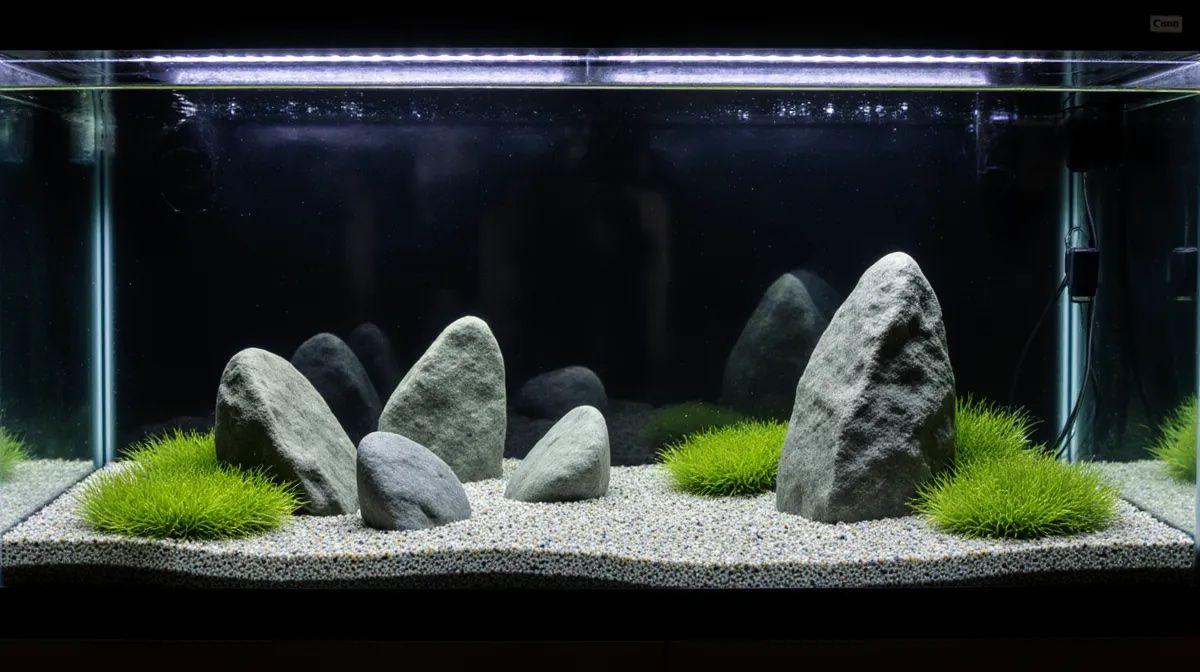
Where the Dutch style celebrates abundance, Iwagumi is an exercise in restraint. Rooted in Japanese garden design principles, the style typically uses an odd number of stones — most often three or five — arranged according to strict compositional rules, paired with a low, uniform carpet of a single plant species.
The Rule of the Oyaishi
Every Iwagumi layout is built around the "oyaishi," or main stone — the largest and most visually dominant rock in the arrangement. It is never placed dead center; classic composition puts it roughly two-thirds across the tank, following the same golden-ratio thinking used in photography and painting. Secondary stones ("fukuishi") are smaller, echo the main stone's shape and texture, and lean toward it to suggest a single, cohesive rock formation rather than scattered boulders.
Choosing and Placing Stone
Consistency of stone type is non-negotiable — mixing rock types breaks the illusion of a natural outcropping instantly. Popular choices include Seiryu stone for its sharp, dramatic texture and Ohko (dragon) stone for a softer, more weathered look. Bury the base of each stone slightly in the substrate; stones that appear to merely sit on top of the gravel read as staged rather than found.
Why Simplicity Is Harder Than It Looks
With so few visual elements, every flaw is magnified. A single stone at the wrong angle or a carpet plant that grows unevenly can undo the entire composition. This is precisely why Iwagumi tanks demand disciplined water chemistry: since there is nowhere for imperfections to hide, stable CO2, consistent lighting, and a tight nutrient regimen for the carpet plant are what separate a serene Iwagumi from a bare tank with some rocks in it.